Experience – 10000/10
Malaysia carries a kind of quiet generosity. It is a country remarkably open to different ethnicities and religions, welcoming to people of every shape, size, and story. There is a calm friendliness to it all, a gentle ease that makes you wonder why the rest of the world can’t manage the same thing.
That openness became especially clear when Ramadan arrived. The truth was, I knew absolutely nothing. I felt like a bee flying straight into a storm. The idea of dry fasting for an entire month sounded, to my very Western brain, slightly insane, and I couldn’t help wondering why anyone would willingly put themselves through it. But what surprised me most was how unawkward it all was. You ask questions that must sound painfully obvious to your Muslim friends, yet instead of annoyance, you’re met with genuine warmth. There’s a grin, almost a quiet pride, in knowing that some clueless Westerner actually wants to understand Islam a little better. And in many ways, Ramadan is the best time to start asking.
But what is the best way to experience Ramadan? Do it!
I am not saying commit to the full 29/30 days, but try doing one. This is exactly what I did. You will procrastinate on it because it takes a lot of effort, but just do it!
Waking up at 5:30am is the first challenge. In Malaysia, where it consistently gets light at 6:30am, it’s a tough start. Being awake for Suhoor is vital. This is the meal you consume before the crack of dawn. Usually, whatever satisfies you, but it needs to be a hearty meal that gives you energy to survive the whole day. I consumed a healthy portion of yoghurt, granola and honey, with dates to fill the rest of my stomach. And oh my, dates are something to admire. Not widely consumed in Western culture, they provide significant nutritional value and effective hydration. Pretty much a super food in my eyes.
Now revived and ready to embrace a day of noble starvation and slow dehydration, I set off. The morning was harmless enough. Quiet. Manageable. The sort of calm that tricks you into thinking you’ve got this whole fasting thing under control.
The trouble begins when other people start eating. Someone cracks open a drink, another unwraps something greasy and fragrant, and suddenly your body betrays you. Your mouth floods with saliva like a dam ready to burst. You’re no longer a rational adult; you’re a wolf eyeing up a particularly oblivious lamb. Routine becomes a kind of torture. The habits you never noticed, snacking and mindless bites, taunt you. Friends, of course, find this hilarious. They eat louder. Slower. It’s character building, apparently. And in a way, it is, this quiet test of restraint, the stubborn refusal to give in.
But the real reckoning arrives mid-afternoon.
Around 3pm, I ceased to function as a human being. Thoughts slowed to a crawl. Movement felt optional. Speech, ambitious. I lay there, half-conscious, watching dreadful daytime television, contemplating whether merging permanently with the mattress might be the better option. Time stretched, warped, refused to move at any respectable pace.
And then, finally, salvation.
When the moment comes, it comes fast. One minute you’re a shell of a person, the next you’re vertical, alert, and halfway out the door with the urgency of a man who’s just remembered he left the oven on. Destination: the bazaar.
The evening bazaar beside the steel mosque in Putrajaya is less a market and more a full-contact sport. By 6:15, it’s already in full swing; crowds surging, bodies weaving, a low-level chaos that feels oddly coordinated. It’s like a children’s mosh pit, but everyone’s holding food and nobody’s entirely sure where they’re going.
There are stalls, hundreds, it seems, spilling out everything from the Malaysian canon to global cameos. Nasi lemak, roti canai, and roti john sit proudly alongside fried chicken, burgers, and the occasional confused attempt at Japanese or Western fare. Ignore those. They’re distractions. You didn’t fast all day for a mediocre burger. Stick to the local playbook. Anything with “nasi” in the name is a good place to start.

I went for nasi ganja. An alarming name, admittedly, and a handful of curry puffs, which I can only describe as what might happen if a Cornish pasty went travelling; Spiced potatoes, crisp pastry, deeply satisfying.
Now, crucially: you don’t eat. Not yet. However much your body protests, there are rules. It’s considered poor form to dive in before sunset. So you find a place to sit, ideally somewhere by the river behind the mosque, where the crowd softens into something calmer. People gather, families unpack, conversations hum quietly. Across the water, the pink mosque glows in the fading light, and for a moment, everything feels suspended. Waiting.

Then you hear it.
At first distant, a voice rising, stretching across the air. Then another, and another, each call to prayer echoing from different mosques, building, overlapping, rolling forward like a slow, melodic Mexican wave. It gathers strength, moves through the city, until it reaches you.
And just like that, it’s time.
No ceremony, no hesitation. Hands in, no cutlery, guided by the now-essential three-finger technique. The first bite of nasi ganja lands like a revelation; rich, spiced, deeply comforting, the kind of flavour that makes you briefly question why you ever ate casually before. The chicken is crisp and tender. Every taste feels heightened, borderline overwhelming, as if your senses have been waiting all day for this exact moment.
The curry puffs follow. A crunch giving way to soft, spiced filling. And then the watermelon juice: cold, sweet, impossibly refreshing. It doesn’t just quench thirst; it resets you entirely. You go from hollow to human again in a matter of minutes.


This is where things take a turn from curious observer to something far more personal, an experience that feels, in every sense, once-in-a-lifetime. The invitation to pray. Not to watch, not to hover awkwardly at the edges, but to step in and take part. It’s equal parts humbling and disorienting. If you’d told me six months ago, back in the UK, that I’d be doing this, I’d have laughed it off.
But here we are.
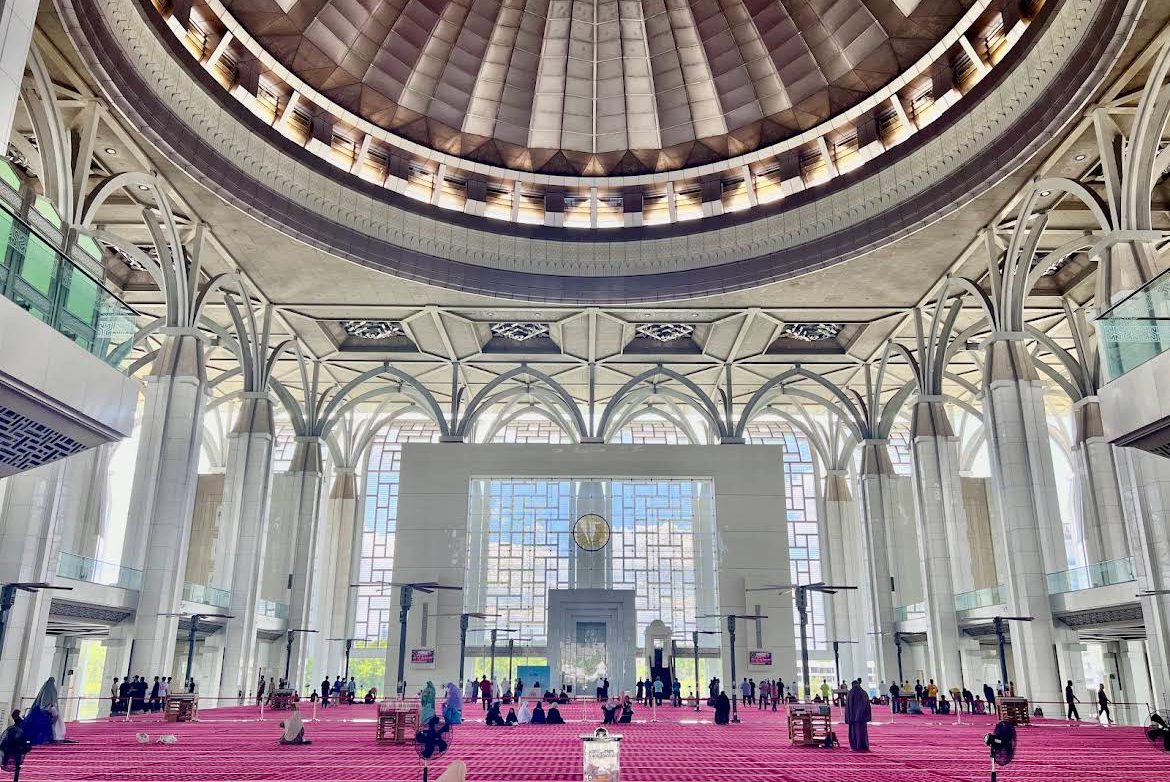
It’s Maghrib, the fourth prayer of the day, and by all accounts the busiest. The steel mosque swells with people, a steady current of bodies moving with purpose. And then there’s me, conspicuous, slightly stiff, acutely aware of every glance. Not hostile, just curious. Still, it carries that feeling of having wandered into someone else’s living room uninvited.
Luckily, I’m not alone. My friend acts as both guide and buffer, easing me through the rituals with a calm familiarity. First comes Wudu – the act of washing. Hands, mouth, nose, face, arms, feet. Three times each. Methodical, almost meditative.


Then into the mosque itself.
It opens up suddenly – vast, airy, serene. The space hums, but softly. There’s a warmth to it, not just physical but atmospheric, like the building itself understands why people are here. You fall into line, shoulder to shoulder, strangers but not separate. The prayer begins, and I do what any sensible outsider does: follow. Movements, pauses, the rhythm of it all.
When it ends, there’s no grand moment. No revelation. Just a quiet sense of having been allowed in, however briefly, to something meaningful. And that is enough.
Stepping outside later, around 9pm, the atmosphere has changed again. The mosque grounds are alive, families gathered in clusters, friends sprawled out on the grass, laughter cutting through the warm night air. There’s food, chatter, the easy comfort of people simply being together. It’s familiar in a distant way, like a rare sunny afternoon in the UK when everyone flocks to the park.

Ramadan, as it turns out, isn’t really about the absence of food or drink. That’s just the headline. The real story is everything that fills the gaps in between – the patience, the small battles with yourself, the quiet recalibration of what you need versus what you think you need. It strips things back, then builds them up again, a little more honestly.
And somewhere between the hunger, the waiting, the shared meals, and moments like that prayer, you realise it’s not about becoming someone else. It’s about meeting yourself, properly, perhaps for the first time in a while, and finding that you’re a little more resilient, a little more aware, and a lot more human than you’d given yourself credit for.